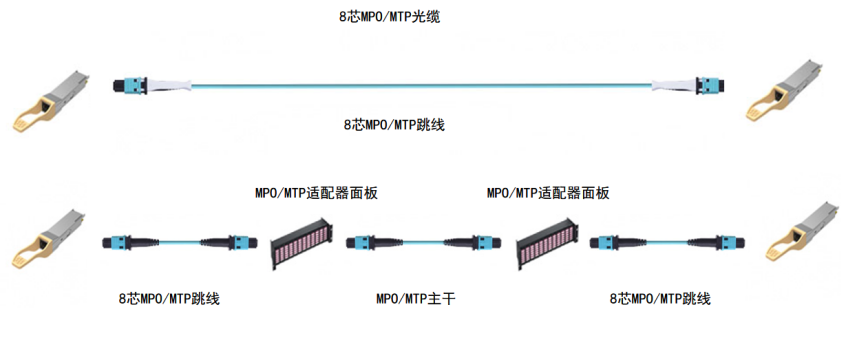
MTP/MPO principle, structure and application

I. What is MTP/MPO?
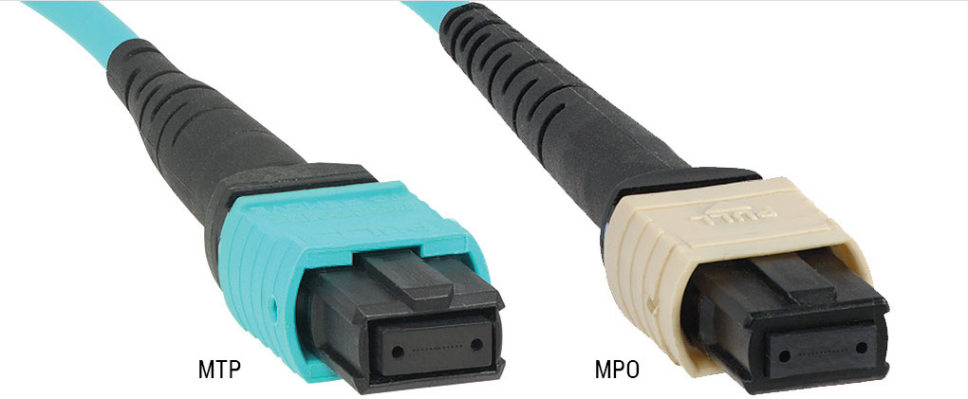
MPO and MTP are both multi-core fiber push-pull connectors, which are standard interfaces for high-density parallel optical transmission.
MPO: Multi-fiber Push On, a general technical name for multi-fiber connectors, conforming to IEC-61754-7 and EIA/TIA-604-5 (FOCIS 5) standards.
MTP®: A registered trademark of US Conec, it is a high-performance MPO that is superior in mechanical precision, optical performance and reliability, and is widely used in high-end data centers and high-speed modules.
The two are compatible and can be connected. MTP represents the high-end precision type, while MPO is the general standard type.
1. Regarding the number of cores in MTP/MPO
According to the IEC-61754-7 and EIA/TIA-604-5 (FOCIS 5) standards, 12 optical fibers are usually arranged in a row, which can support one or more rows of optical fibers in the same MPO connector, up to a maximum of 144 fibers.
2. About MPO
MPO fiber optic connectors include fiber optic cable, sheath, coupling assembly, metal ring, pins, and dust cap. The pin portion comes in male and female versions. Male connectors have two pins, while female connectors do not.
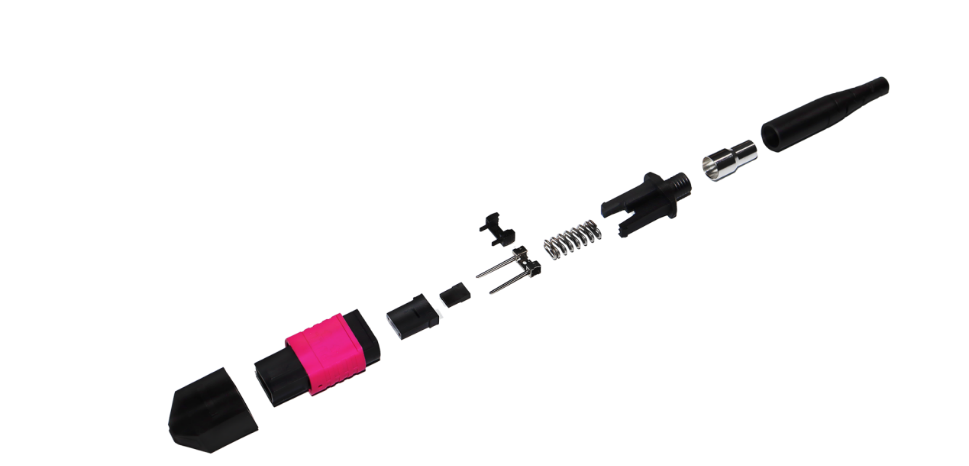
*MPO teardown diagram
Type A (Straight-through): The fiber cores at both ends of the jumper are arranged in the same position, that is, 1 on one end corresponds to 1 on the other end, and 12 on one end corresponds to 12 on the other end. The keys at both ends face opposite directions, with key up corresponding to key down.
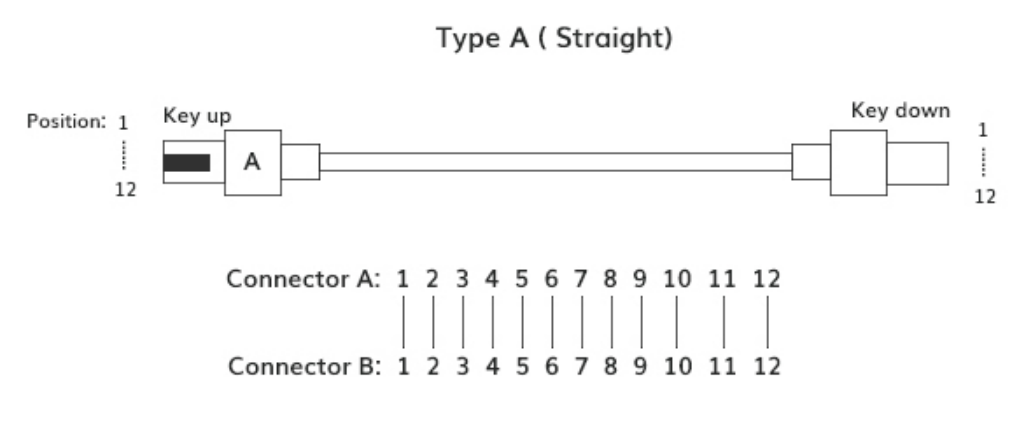
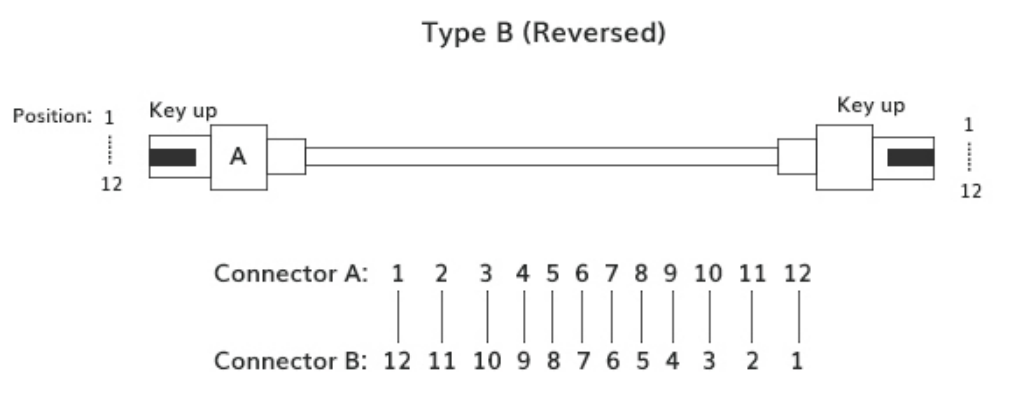
Type B (Interleaved): The fiber cores at both ends of the jumper are arranged in opposite positions; that is, 1 at one end corresponds to 12 at the other end, and vice versa. The keys at both ends face the same direction; that is, key up corresponds to key up, and key down corresponds to key down.
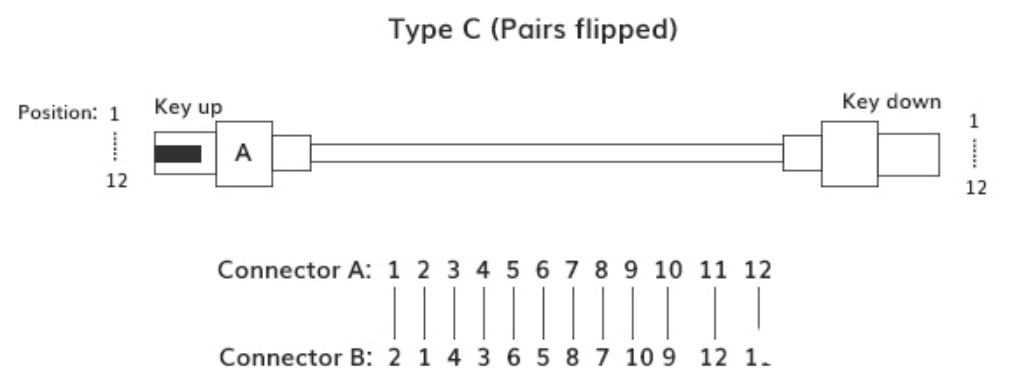
Type C (Paired Interleaved): In Type C MPO jumpers, adjacent pairs of cores are interleaved, meaning core 1 at one end corresponds to core 2 at the other end, and core 12 at one end corresponds to core 11 at the other end. The key orientations at both ends are also opposite, with key up corresponding to key down.
II. What is AR MPO?
AR MPO typically refers to Angled Remote/Angled Physical Contact (APC) MPO, which is a multi-core fiber optic connector with beveled end faces. Its key difference from a regular MPO (usually a UPC/PC end face) lies in the end face polishing angle and optical reflection performance, leading to differences in application scenarios, appearance, and compatibility.
Comparison of core differences
1. End face structure and optical performance (the most fundamental difference)
Standard MPO (UPC/PC)
End face: Vertical/micro-spherical polished (approximately 0°).
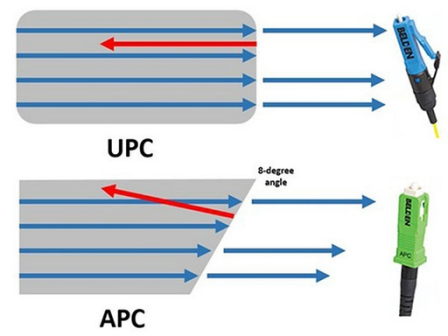
Return loss (RL): Approximately 50~55 dB. Some of the reflected light will return to the source along the same path, which can easily interfere with high-speed or long-distance transmission.
Insertion loss (IL): Standard, approximately ≤0.5dB.
AR/APC MPO
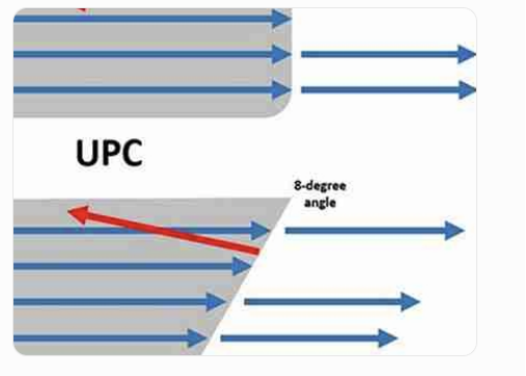
End face: 8° bevel polished.
Return loss (RL): ≥60~65 dB. The reflected light is guided by the cladding, greatly reducing echo interference.
Insertion loss (IL): Slightly better than ordinary MPO, with low-loss type reaching ≤0.3dB.
2. Appearance markings
Standard MPO (UPC): The housing, adapter, and jumper sheath are typically black, beige, or blue.
Standard MPO connector
AR/APC MPO: The standard color is green, making it very easy to distinguish.
3. Compatibility
Never mix them: UPC and APC have different physical structures on their end faces. Forcing them together will cause end face wear, a sharp increase in insertion loss, and signal degradation.
Internal structure: The number of cores (12/24 cores), polarity (A/B/C), and male/female pins are completely consistent with the standard MPO.
4. Main application scenarios
Standard MPO (UPC)
Multimode fiber (OM3/OM4/OM5)
Short-range high-speed: Short-range (<150m) parallel optical connections such as 40G/100G/400G SR4 within the data center.
For general local area networks that do not have strict requirements for return loss.
AR/APC MPO
Single-mode fiber (OS2)
Long-distance, high-sensitivity: 5G base stations, CATV, long-distance backbone networks, wavelength division multiplexing (WDM) systems.
Analog/RF optical transmission: Scenarios that are extremely sensitive to reflected noise (such as RoF, distributed antennas).
400G/800G Single-Mode High-Speed: DR4/FR4 Equal-Length Module.
III. Applications of MTP/MPO
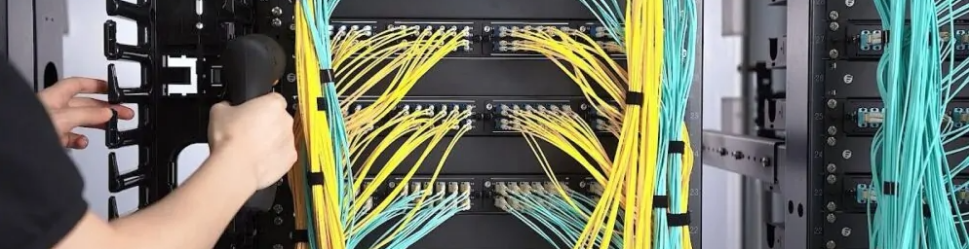
1. High-speed transceiver module:
MTP/MPO enables parallel transmission of multiple optical signals, improving the rate and capacity of transceiver modules, and is suitable for high-speed optical communication systems such as 40G, 100G, 200G, and 400G.
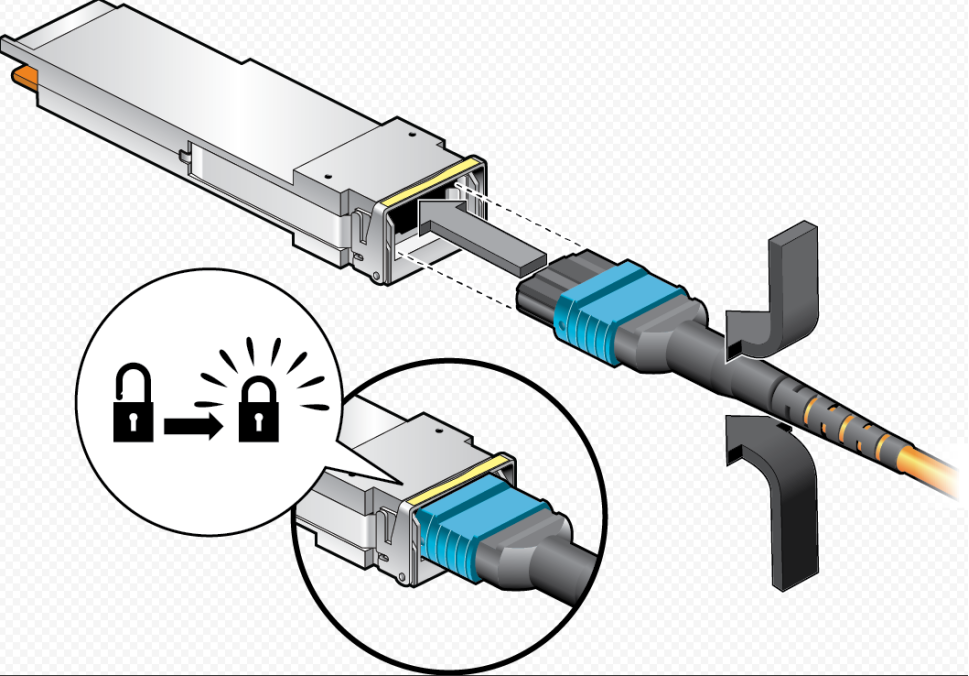
2. Fiber Optic Interconnection:
MTP/MPO enables fast and flexible interconnection between optical fibers, reduces insertion and removal losses and dust problems, improves fiber utilization and network capacity, and is suitable for fiber optic communication applications such as data centers and 5G mobile communications.