
Polarization-Maintaining Optical Fiber Devices

Polarization-maintaining optical fiber devices: The technical cornerstone empowering the next generation of optical communications
With the acceleration of the implementation of 5G-A (5G-Advanced), AI computing power clusters, and East Digital and West computing projects, optical communication networks are facing three core challenges: ultra-high bandwidth, ultra-low latency, and ultra-long-distance transmission. In this context, the polarization mode dispersion (PMD) problem of traditional single-mode fibers has become a bottleneck that limits performance, and PM fiber components are becoming a key enabling technology in high-speed coherent communication, quantum communication, silicon-optical integration, and other fields with their unique polarization maintenance capabilities.
01 Science popularization classroom
1. Daily life of ordinary optical fiber: social butterfly
Ordinary single-mode optical fiber is like a "social expert," and the optical signal can be twisted as much as you like in it: horizontal polarization? Vertical polarization? Twist it diagonally into a twist? It doesn't matter; it can be passed on!
Result: When the signal reaches the endpoint, the polarized state is "too drunk to recognize the father," resulting in signals fighting each other during high-speed communication (PMD effect).
Engineer: "Can your polarization be more stable?!"
Ordinary fiber: "Freedom! It's my attitude!"
2. The birth of polarization-preserving optical fibers: the "obsessive-compulsive patients" of the optical fiber industry
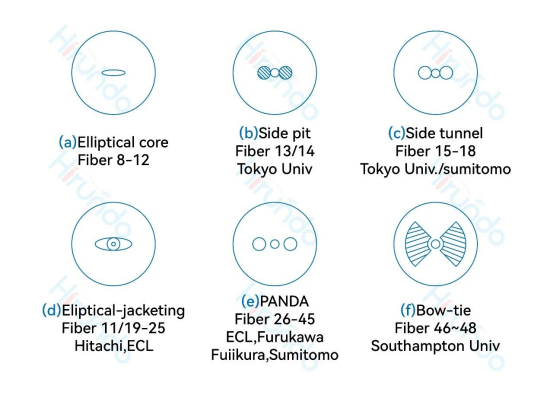
In order to cure this problem of "writhing at will," scientists have added two "physical plug-ins" to optical fibers:
Move 1: Panda-type protection—symmetrical majesty
Stuff two "panda eye" stress rods (actually borate glass) on both sides of the core.
Principle: These two "dark circles" desperately pull the optical fiber, causing asymmetric stress inside the fiber core.
Effect: As soon as the light signal comes in, it is "fixed by pressing the head": "Only shake vertically, not horizontally!"
Light signal: "I want to walk diagonally..."
Panda PM: "No, you don't want to." (Cold)
Move 2: Bow tie type to protect bias—violent aesthetics
Directly make the fiber core into a "bow tie shape" to physically block the way of other polarization directions.
Principle: It's like stuffing light into a tunnel with only one line and hitting the wall if you dare to turn a corner!
Engineer: "Can this polarization still change?"
Bow tie to protect the part: "Try and die." (Smile)
02 Our solution: full-scenario bias protection product matrix
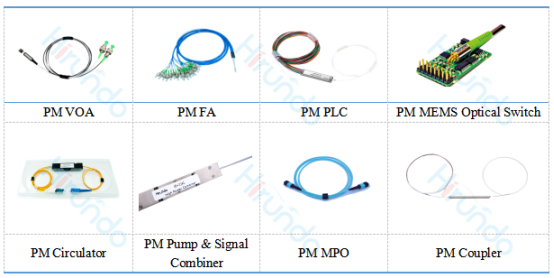
In response to the cutting-edge needs of optical communication, we have launched a family of high-reliability polarization protection devices, covering the core technologies of the entire chain of design, manufacturing, and testing:
1. PM Patch Cord
Features: Panda/bow tie type fiber is optional, with a matting ratio of > 25 dB and a working wavelength covering 780 nm~2 μm.
2. PM Coupler
Breakthrough: Based on the fusion cone technology, 1×2/2×2 spectroscopy is realized, with a polarization-related loss (PDL) of <0.1 dB, supporting harsh environments of -40°C~85°C.
3. PM Isolator
Advantages: Reverse isolation > 40 dB, suitable for narrow linewidth lasers (such as EML), helping to miniaturize CPO (co-packaged optics) packages.
4. PM MEMS Optical Switch
Our polarization protection (PM) MEMS optical switch can support the number of channels 1xN (2≤N≤32); Wavelength: 1310±30 or 1550±30; extinction ratio (PER) dB≥18; switching response time ≤ 20 ms; drive voltage: 5-12V.
5. Polarization Protection Division Multiplexer (PM WDM)
Polarization-Guaranteed CWDM and Polarization-Maintained DWDM (Available Channels 1/4/8/12/16/18)
03 Technology Highlights: Why Choose Us?
Military-grade accuracy: Fully automatic axis welding technology, polarization axis alignment error <1°.
Full link test: Passed OTDR, polarization analyzer (such as EXFO PSO-200), and strict quality inspection.
Customized services: Support customers to specify fiber types (such as PM1550 and PM1300) and connectors (LC/APC and MPO).