Optical switches: "transportation hubs"

Optical switches: "transportation hubs" for building intelligent optical networks
1. Optical switch
An optical switch is an optical device with one or more selectable transmission ports.
Capable of physically switching or logicing signals in optical transmission lines or integrated optical paths
operation. It is widely used in optical network protection, system monitoring, path selection, and other scenarios.
It is the basic component for building reliable and intelligent optical networks.
2. Type
Optical switches are widely used in optical fiber communication systems, and their implementation technologies are diverse:
◆Mechanical optical switch
◆Hot light switch
◆Sound and light switch
◆Electric optical switch
◆Magneto-optical switch
◆ LCD optical switch
◆MEMS optical switch
……
Among them, mechanical optical switches and MEMS optical switches have become the two most widely used mainstreams due to their mature technology and stable performance.
3. Mechanical optical switches: classic and reliable "veterans"
Mechanical optical switches usually use a 1×N or M×N port structure, and the external electrical signal triggers the driving components (relays, motors, etc.) to drive the prism, mirror, or optical fiber itself to displace so as to realize the switching of the optical path. There are 3 main types:
✧ Prism switching optical path technology is adopted;
✧ Mirror switching technology is adopted;
✧ Switch the optical path by moving the fiber
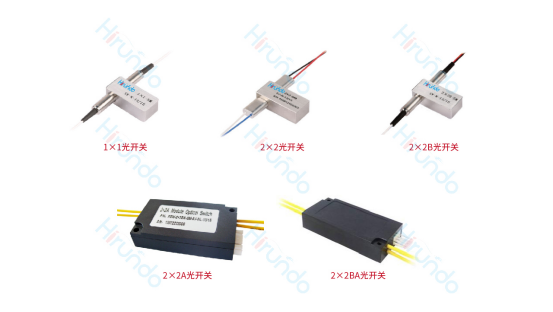
The prism (or mirror) switching optical path technology is used to control the prism displacement based on the relay powering on/off the relay. Common optical switches include 1×1, 1×2, 2×2 (2x2A), 2×2B (2x2BA), D1×2, D2×2B, etc., all of which belong to this type of optical switch.
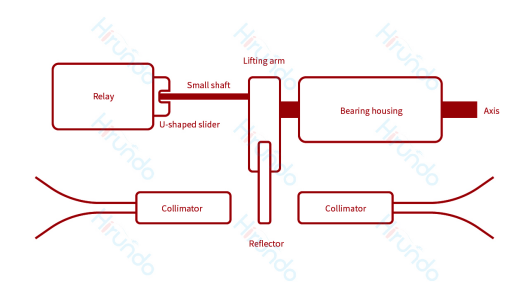
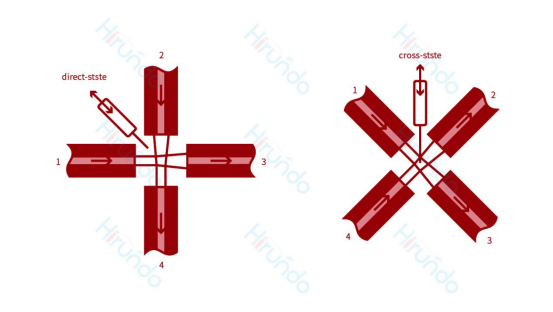
The following is an example of a moving mirror type 2x2 mechanical optical switch driven by an electromagnetic relay
Control logic
Uses the polarity of the voltage (positive/negative) to control the two different operating states of the electromagnetic relay.
Correspondence
► +5V → relay action A → The mirror exits the optical path and passes through.
► -5V → Relay Action B → Mirror inserts the optical path → The optical path crosses.
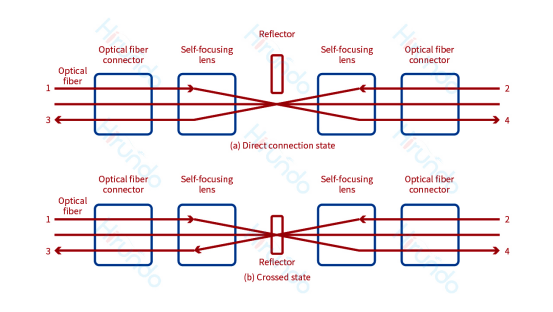
Pass-through state
When the mirror does not enter the optical path, the optical switch is in the pass-through state, and the light entering optical fiber 1 enters optical fiber 4, and the optical entering optical fiber 2 enters optical fiber 3;
Crossover state
When the mirror is at the intersection of two rays, the optical switch is in the crossover state, and the light entering fiber 1 enters fiber 3, and the light entering fiber 2 enters fiber 4, so as to realize the switching of optical paths.
The mobile optical switch is a fixed optical fiber at one end, and the moving optical fiber at the other end is coupled with different ports of the fixed optical fiber to realize the switching of optical paths.
4. MEMS optical switches: a precise and efficient "new star"
MEMS optical switches are based on micro-electro-mechanical systems, which use optical micromirrors or optical micromirror arrays to change the propagation direction of the beam to realize the switching of optical paths. It is a new type of microcomputer-electrical-optical integration produced by the combination of semiconductor microfabrication technology and micro-optics and micro-mechanical technology, which is the mainstream direction of the development of large-capacity switched optical network switches
The principle of MEMS optical switching is very simple: when light is exchanged through the drive of electrostatic force or magnetic power, the angle of the MEMS micromirror is moved or changed, and the input light is switched to different outputs of the optical switch to realize the switching and switching of the optical path.
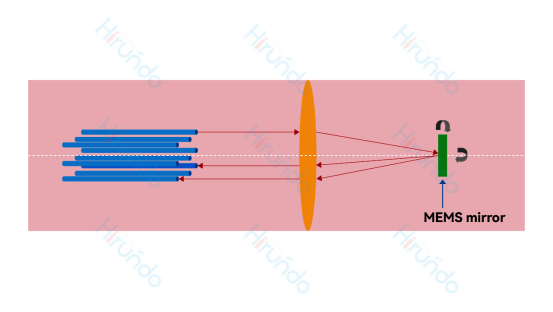
The principle of the 2×2-port optical switch based on MEMS technology is shown in the figure:
When the micromirror does not intervene in the optical path, the beams from waveguides 1 and 2 are coupled to waveguides 3 and 4, respectively, and the port connection states are 1→3 and 2→4, which is the pass-through state.
When the micromirror is inserted into the optical path, the beams from waveguides 1 and 2 are reflected by the micromirror and coupled to ports 4 and 3, respectively, and the port connection states are 1→4 and 2→3, which is the crossover state.
5. Advantages and disadvantages of mechanical optical switches and MEMS optical switches
|
Mechanical optical switch |
MEMS optical switches |
|
|
How it works: |
Optical path switching is achieved by mechanically driving the physical displacement of mirrors, prisms, or optical fibers |
The micromirror is deflected by electrostatic force or electromagnetic force, and the reflected light path is switched |
|
Reliability |
The technology is mature, but there are mechanical wear, rebound, jitter, etc., and the service life is relatively limited |
No mechanical contact wear, long life, high stability, and reliability Strong |
|
Power consumption |
High (need to drive motors, relays, and other mechanical components) |
Low (electrostatic drive, low energy consumption) |
|
Cost |
Medium and low, mature technology, suitable for small- and medium-scale applications |
The upfront manufacturing cost is high, making it suitable for integrated and large-scale application scenarios |
Mechanical optical switches are more suitable for scenarios that do not require high speed but have high requirements for stability, isolation, and cost control. MEMS optical switches are more suitable for high-speed, highly integrated, and scalable optical network systems, especially for large-capacity and intelligent scheduling all-optical switching networks in the future, which represent the mainstream direction of technological development. Both have their own advantages, and the actual selection needs to be comprehensively considered in combination with specific application scenarios, performance requirements, and system architecture.
6. About us
Hirundo is committed to providing high-performance, high-reliability optical switch solutions:
✅ Mechanical optical switches: 1×1, 1×2, 1×N, 2×2, 2×2B, and other models with mature technology;
✅ MEMS optical switch: with the characteristics of fast switching, high isolation, low loss, small size, high reliability, etc.;
✅ It supports customized solutions and can be widely used in optical network monitoring, device testing, OXC device core switching, and other fields.