Semi active products

Innovation and application of passive device technology in backbone network OTN/WDM solutions
Innovation and application of passive device technology in backbone network OTN/WDM solutions
With the rapid development of 5G, cloud computing, and other technologies, the demand for ultra-large bandwidth, low latency, and flexible scheduling in backbone networks has surged. OTN/WDM technology has become the core bearing solution of modern backbone networks due to its high capacity, long-distance transmission, and intelligent management capabilities. As a manufacturer of fiber optic passives, we provide key foundational components for OTN/WDM systems through technological innovation, helping to build efficient and reliable transmission networks.

1
OTN/WDM architecture is integrated with passive devices
The backbone OTN/WDM system adopts a hierarchical architecture (optical channel layer OCh, optical multiplexing segment layer OMS, optical transmission segment layer OTSL), in which passive devices play an irreplaceable role in optical layer signal processing.
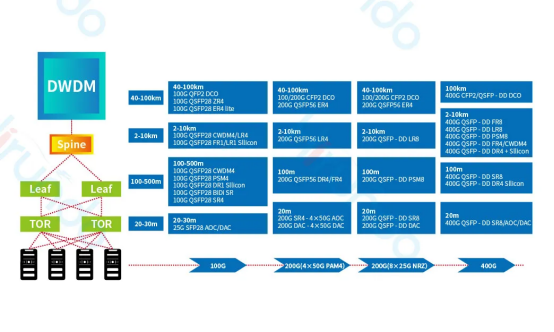
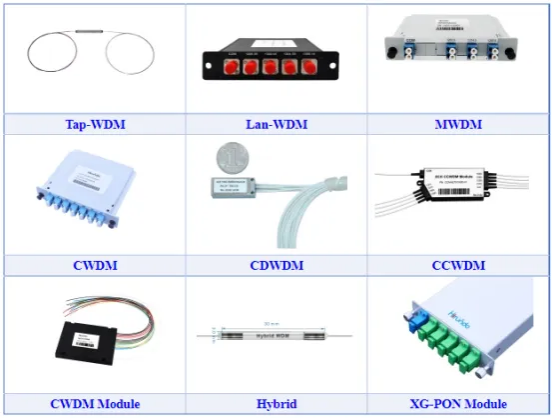
WDM
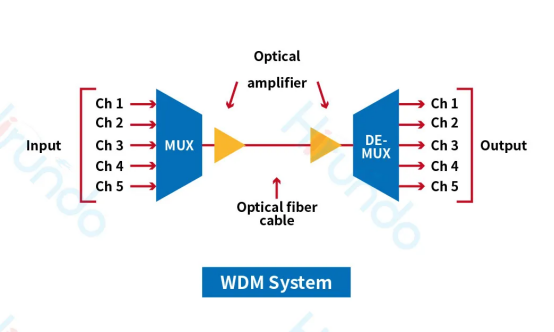
It supports DWDM/CWDM technology to achieve transmission of more than 96 waves per fiber (channel spacing can be customized by 0.8 nm/20 nm) and achieves an insertion loss of <0.3 dB and wavelength isolation of >35 dB through a precision optical coating process.
Optical isolator
Faraday rotating magneto-optical crystal technology is used to achieve a > 40 dB reverse isolation degree, effectively preventing reflection damage from EDFA and other active devices.
Optical Splitter
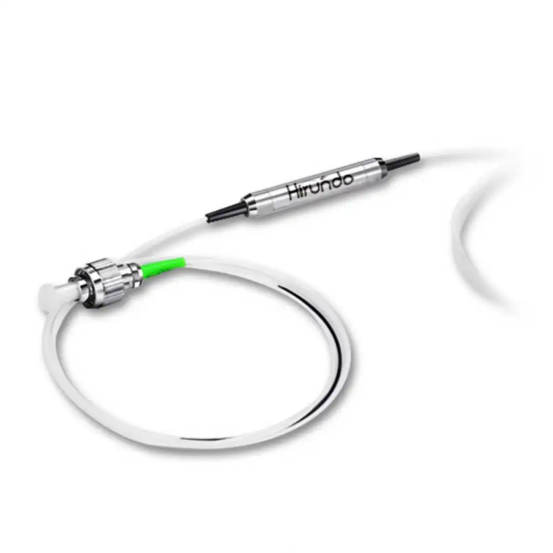
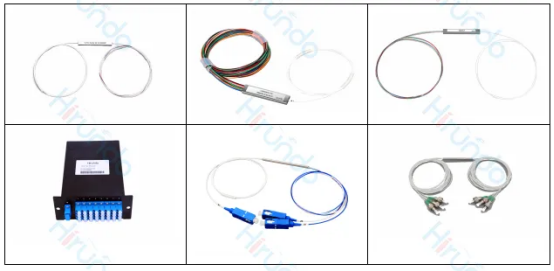
The 1×N spectroscopy ratio accuracy is ±0.5 dB, and it supports wavelength-independent spectroscopy, making it suitable for optical power monitoring and service protection switching scenarios.
2
Technological breakthroughs in passive devices
In response to the ultra-long-distance transmission needs of backbone networks, our products have achieved breakthroughs in the following areas:
Anti-nonlinear design
By optimizing the radius of curvature of the fiber end-face microlens (<5 μm), the four-wave mixing effect in high-power scenarios is reduced, and 400G QPSK/16QAM modulated signal transmission is supported.
Wide temperature stability
The operating temperature range is extended to -40°C~85°C to meet the deployment needs of field optical relay stations.
Intelligent integration
Develop hybrid passive devices (such as a WDM + isolator + beam splitter 3-in-1 module) to reduce the size by 60% and adapt to the high-density deployment of OXC all-optical switching equipment.

3
The overall solution advantages brought by technological innovation
These passive innovations directly enable the next generation of OTN/WDM backbone solutions
Ultra-high speed and large capacity
The wide application of C+L band systems makes the single fiber capacity easily exceed 40 Tb/s. Low-loss, high-performance MUX/DeMUX and WSS are the physical foundation that underpins this capacity.
Flexibility and intelligence
The maturity of WSS and tunable devices has changed the network from a "static pipeline" to a "flexible mesh." SDN controllers can control WSS to create, adjust, or remove optical channels on demand in real time, achieving "on-the-go" bandwidth.
High reliability
High-performance passive devices (e.g., optical switches, WSS) enable fast and lossless optical layer protection switching, providing a more efficient and lower latency recovery method than electric layer protection.
Low power consumption and low cost
Device integration reduces fiber splice junctions and independent packages, reducing insertion loss and power consumption. Automated production and miniaturization reduce the cost of a single device, which in turn reduces the construction and operation and maintenance costs of the entire system.
4
Use Cases
The 96-wave DWDM+OTN electrical crossover scheme is used to deploy a high-density optical fiber ring (IL<1.2dB) and dimmable optical attenuator (adjustment accuracy ±0.1dB) to achieve 200G service bearing across 4000 km across provinces.
Data Center Interconnect (DCI)
Build an all-optical mesh network with silicon-based hybrid integrated devices, supporting 1.6 Pbps switching capacity in a single rack and reducing power consumption by 45%.